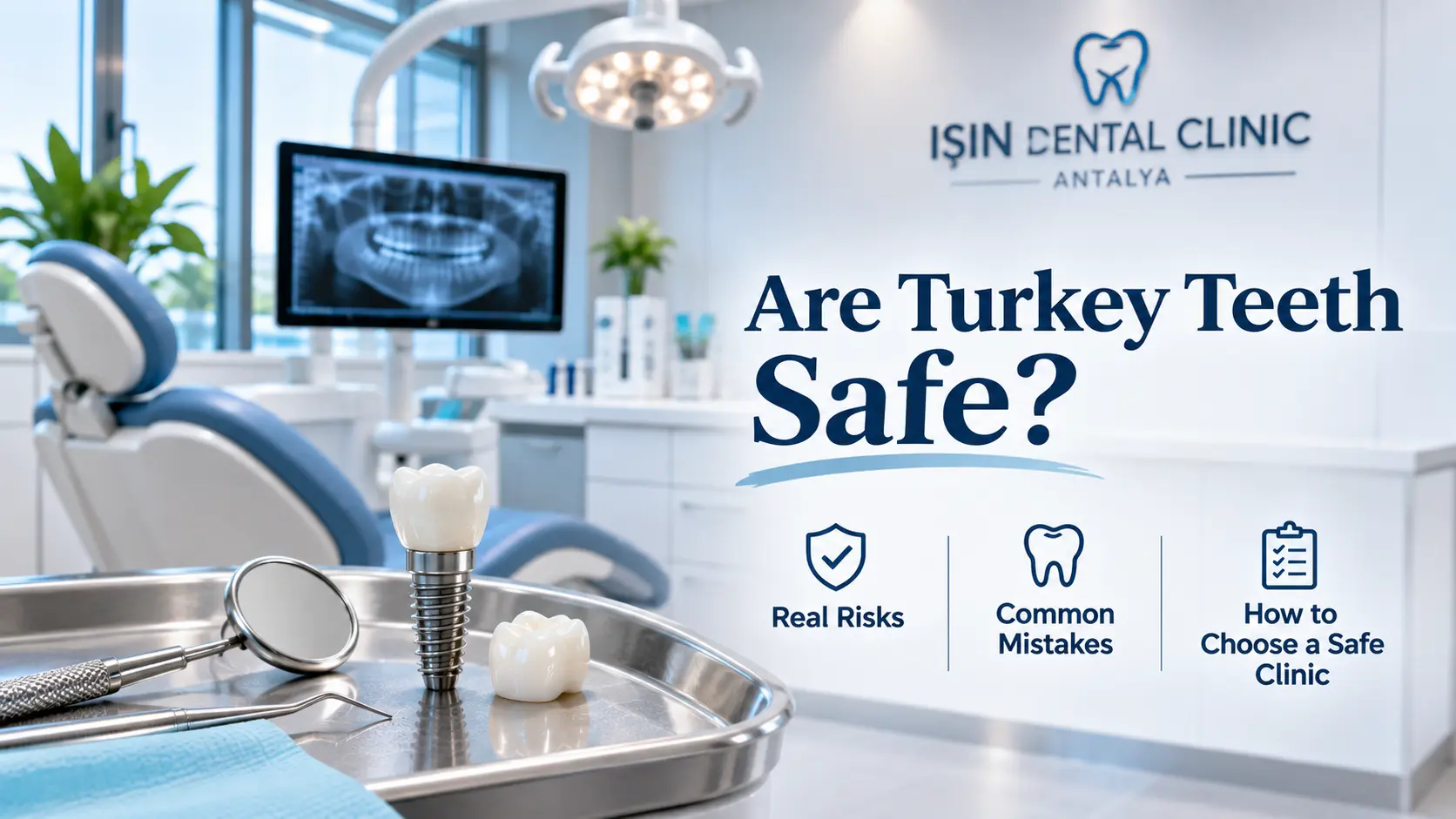
Yes, with a condition attached that matters more than the answer. Turkey teeth are as safe as the clinic that fits them, and the treatment itself is ordinary dentistry that happens in UK practices every day. What differs between a good result and the ones that end up on the news is not the country. It is a handful of decisions made before the drill ever touches a tooth.
I have been fitting veneers and crowns in Antalya for years, and I have also seen the other kind: patients who arrive asking us to fix work done somewhere cheaper, usually two or three years after the fact. The pattern in those cases is so consistent that it is worth setting out plainly, because once you know what causes a bad result you can check for it before you book anything.
Three causes account for almost every case I have seen come back for repair. They are all decisions made in the surgery before any ceramic is fitted, which means they are all avoidable. This section is about results that were wrong from the day they were cemented. If what you want to know is why a set that looked fine at first wears out after three years instead of fifteen, that is a different list of causes, and our guide on how long Turkey teeth last covers it.
Over-Filing Healthy Teeth
This is the one behind the photographs that frightened everybody. To fit a crown, the tooth has to be reduced on every surface so the cap has somewhere to sit, which leaves a smaller shape underneath. On a tooth that is already broken, heavily filled or root-treated, that reduction is the correct treatment and the crown is protecting what is left. On a sound tooth with nothing wrong except its colour, the same reduction removes healthy enamel that will never come back.
Enamel does not regenerate. Once a sound tooth has been cut down for a crown, it is committed to being crowned for the rest of your life, and every replacement thereafter removes a little more. That is why the question to ask is never "how much will you file" but "why does this tooth need a crown rather than a veneer", tooth by tooth.
Rushed Treatment Timelines
A proper course of veneers or crowns has a step in the middle that is easy to delete: the try-in. Your finished restorations come back from the laboratory and are placed temporarily, so you can see them in daylight, in a mirror, with your own lips around them, before anything is cemented. If the shade is too bright or the shape is too square, this is the moment it gets changed. After cementing, changing the shade means remaking the whole set.
Clinics that advertise a full smile in two or three days have usually removed that appointment. The work goes straight from preparation to final cementation, and you find out what you have bought when you are back at the airport. Five to seven days in Antalya is not a clinic padding your stay. It is what a try-in and the laboratory work either side of it actually take.
Crowns When Veneers Would Do
Crowns are quicker and more forgiving to fit than veneers. A veneer is a thin shell bonded to the front surface, which demands precise preparation and a careful bond; a crown covers everything and hides small errors underneath. For a clinic working at volume, crowns are the commercially sensible choice, and that is exactly why they get recommended for cases that did not call for them.
The patient usually cannot tell, because both arrive looking like a new smile. The difference shows up years later in how much of your own tooth is left. Our guide on veneers vs crowns sets out when each one is genuinely indicated, and it is worth reading before you accept any plan that puts crowns on your front teeth.
Here are the actual numbers, so you can judge any plan you are given against them.
- Composite bonding: nothing is removed. The resin is added to the tooth surface and can be polished off again. This is the only fully reversible option on the list. See composite bonding.
- Porcelain laminate veneer: roughly 0.3 to 0.5 mm from the front surface only, which is less than the thickness of a fingernail. Some cases need no preparation at all. See laminate veneers.
- E-max veneer: similar to a porcelain laminate, slightly more where the tooth needs reshaping. See E-max veneers.
- Zirconium or porcelain crown: 1 to 2 mm from every surface, including the biting edge. This is the preparation shown in the viral photographs. See zirconium crowns.
Two things follow from that list. First, "Turkey teeth" is not one procedure, and the amount of tooth you lose depends entirely on which of the four you are having. Second, nobody is left walking around with prepared teeth on display: temporary teeth are fitted the same day, which is why patients can go out for dinner in the middle of treatment.
If you want a treatment that keeps all your enamel, say so at the consultation. In a lot of cases the answer is bonding or a small number of veneers rather than a full set of crowns, and a clinic that will not discuss that option is telling you something about how it works.
Not until the gum disease is treated, and this is the warning I would most like UK patients to take seriously.
Crowns and veneers meet the tooth at the gum line, and that join, the margin, is where plaque collects. Cement a restoration onto an inflamed, bleeding gum and you seal bacteria into the one place you cannot clean properly. The gum then recedes over the following year or two, exposing the margin as a dark line, and the beautiful set of teeth you flew home with starts to look wrong from the top down. In the worst cases the supporting bone goes with it and the tooth loosens under a perfectly good crown.
Gum disease is also easy to miss in the photographs you send before travelling. Gums can look pink and healthy in a phone picture while bleeding on probing, which is why the clinical examination on day one matters and why a plan built from photographs alone is only ever a provisional one. If we find gum disease, the sequence is treatment first, healing, then cosmetic work. Sometimes that fits inside the same trip and sometimes it means coming back, and we would rather tell you that than cement crowns onto a problem.
The same applies to decay under an old filling and to a tooth with a failing root treatment. Both need sorting before anything cosmetic goes on top. A clinic that works through this sequence is not being slow. It is the difference between a result that lasts a decade and one that fails in eighteen months.
No, and anyone telling you otherwise is selling. Realistic lifespans, with good hygiene and a night guard:
- Composite bonding: 5 to 7 years before repolishing or replacement.
- Porcelain and E-max veneers: 10 to 15 years.
- Zirconium crowns: 10 to 15 years, often longer on back teeth.
- Dental implants: the titanium post can last a lifetime, but the crown or bridge on top is a wearing part and will need replacing.
Plan for the replacement cost from the start, because it is the number people leave out when comparing a Turkish quote with a UK one. Our guide on how long Turkey teeth last goes through what shortens those figures, and grinding is top of the list, which is why a night guard is included in our packages rather than sold as an extra.
This is the part that actually protects you. Work through it before you pay a deposit anywhere, including with us.
- Check the dentist, not just the clinic. Ask for the treating dentist's name and registration with the Turkish Dental Association, and look them up. A clinic that will not name who is treating you is not one to travel to. Ours are listed on our dentists page with their qualifications.
- Get the materials named in writing. Which implant system, which ceramic, which brand. "Premium veneers" is not a material. If the quote will not name it, you cannot compare it with anything and you will not be able to match it later.
- Confirm there is a try-in appointment. Ask directly: will I see and approve the finished teeth before they are cemented? If the schedule has no room for it, the schedule is the problem.
- Ask for the guarantee terms in writing. How long, what it covers, and what happens if you cannot fly back. A verbal assurance over WhatsApp is not a guarantee.
- Insist on a written treatment plan. Tooth by tooth: which teeth, which treatment, which material, how many days. It should also say what happens if the examination finds something the photographs did not show.
- Read reviews for process, not price. Reviews that only mention how cheap it was tell you nothing. Look for people describing the examination, the try-in, and what happened when they needed something afterwards.
- Be suspicious of the lowest quote. A price far below everyone else is paid for somewhere: cheaper ceramics, fewer appointments, or crowns instead of veneers. The same logic applies to dental implants, as our guide on whether it is safe to have dental implants in Turkey explains.
- Watch how they respond to being questioned. A clinic that answers these questions in detail is one that expects them. A clinic that answers with a discount is not.
Everything above describes what we do, so it is only fair to be specific about it.
Your plan starts from photographs and x-rays, free and with no obligation, and it is provisional until a dentist has examined you. Day one in Antalya is a full clinical examination with a 3D scan, and if that changes the plan, we tell you what and why before any work starts. If it means fewer teeth than you asked for, you will hear that too. The most common conversation we have with UK patients is explaining why they need six veneers rather than twenty.
Teeth are prepared as conservatively as each case allows, and the reason for every crown is explained tooth by tooth. Temporaries go on the same day. Your finished restorations are tried in, in daylight, and cemented only once you have approved the shade and the shape. A night guard is made before you leave, and you fly home with your full records: material, brand and shade for every restoration, so any dentist anywhere can work with what you have.
Our laboratory is on site, which is what makes a proper timeline possible in a single trip rather than something that has to be compressed. And our team stays reachable after you land. If something feels wrong, message us with photographs: most of it is a small adjustment, and knowing early is what keeps it small.
If you want to know what is realistic for your own teeth, send a few photographs through our free online consultation. You will get an honest answer, including if the honest answer is that you do not need what you asked for. For how treatment, hotel and transfers are priced together, see our Turkey teeth packages, and for what the work itself costs, our guide to Turkey teeth cost.
Are Turkey teeth safe?
The treatment is routine dentistry and is safe when it is planned properly and carried out by a qualified dentist with named materials. The risk is not the country, it is any clinic that files healthy teeth for crowns that were not needed, or compresses the work into too few days to try the teeth in before cementing them.
Why do some Turkey teeth go wrong?
Nearly always one of three reasons: healthy teeth prepared too aggressively, a timeline too short for a proper try-in, or crowns fitted where veneers would have done because crowns are faster to deliver. All three are decisions a clinic makes, not an outcome of travelling.
Do Turkey teeth get filed down to pegs?
Veneers need only a small amount of enamel removed, sometimes none. Crowns need the tooth reduced on all sides, which is what the photographs online show. That reduction is necessary on a broken or root-treated tooth and unnecessary on a sound one, so the real question is whether you needed crowns at all.
Can I get Turkey teeth with gum disease?
Not until the gum disease is treated. Cementing crowns or veneers onto inflamed gums traps bacteria at the margin and the gum recedes within a year or two, leaving dark lines. Gum treatment comes first, which may add a few days or mean coming back, and any clinic that skips this step is the problem.
Do Turkey teeth last forever?
No. Composite bonding lasts around 5 to 7 years, porcelain veneers and zirconium crowns 10 to 15 years with good care. Implants themselves can last a lifetime, but the bridge on top will need replacing. Anyone promising a permanent result is overselling.
How do I know if a Turkish dental clinic is safe?
Check the dentist is registered with the Turkish Dental Association, ask which implant system and which ceramic in writing, confirm there is a try-in appointment before cementing, get the guarantee terms in writing, and look for reviews that describe the process rather than just the price.
Will a UK dentist treat work done in Turkey?
Almost all will. Some say plainly that they will not guarantee another dentist's work, which is fair, but refusing routine care is rare. Take home your treatment records, including the material, brand and shade, so a UK dentist can match or repair the work later.