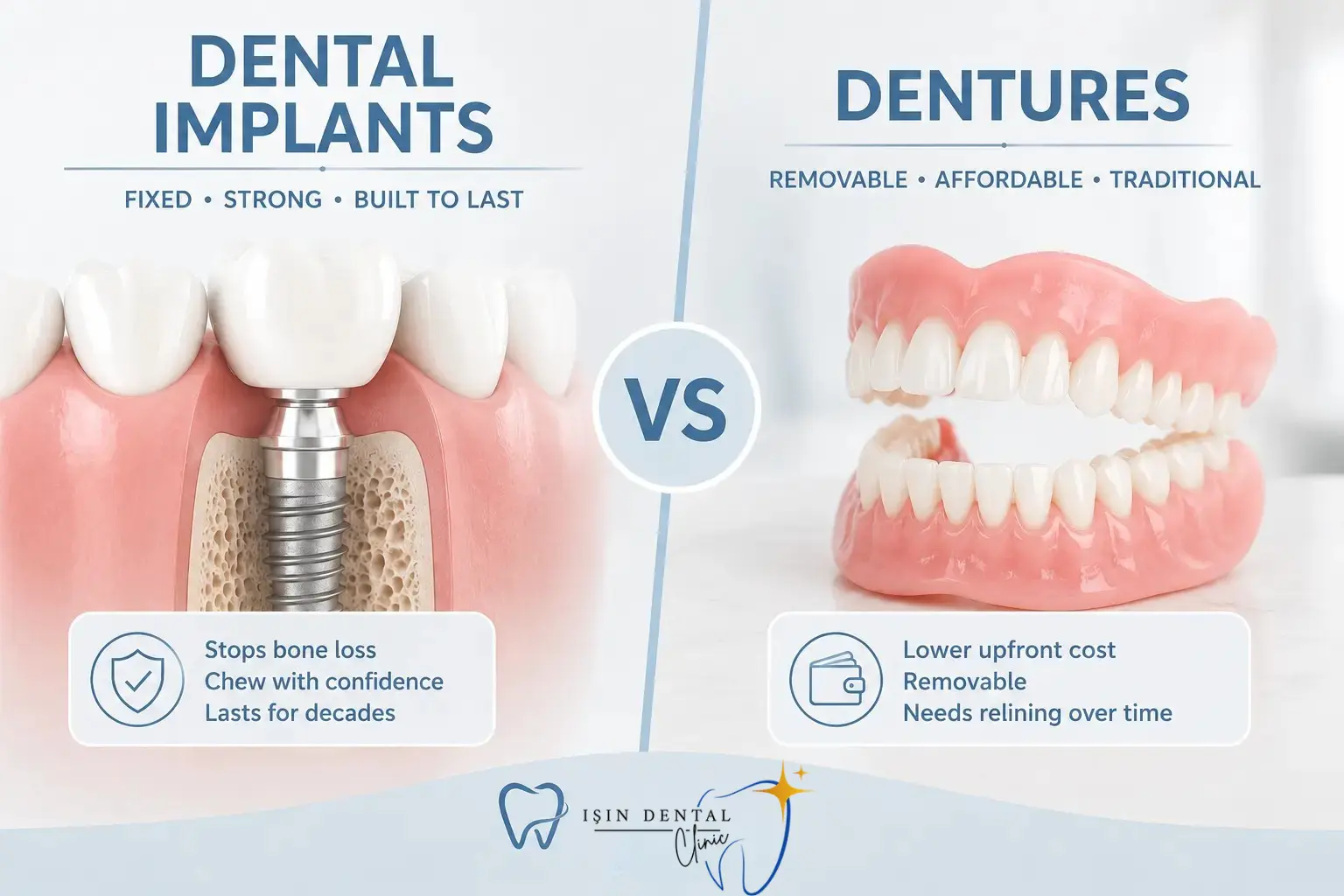
Dental implants are titanium posts placed into the jawbone that carry fixed teeth permanently. Dentures are removable prosthetics that rest on the gum. The practical difference is that implants replace the tooth root as well as the visible tooth, so they hold bone, restore close to natural bite force and do not move. Dentures replace only what you can see, cost less upfront, need no surgery, and have to be remade as the jaw underneath shrinks. Implants are the better long-term answer for most people who can have them. Dentures remain the right answer for some.
I place implants every week for patients who fly to Antalya from the UK, and a large share of them have worn a denture for years before deciding they have had enough of it. What follows is the honest comparison I give them in consultation, including where dentures genuinely win.
This is the difference patients notice first and talk about most. A full upper denture covers the palate and is held by suction, so the force you can safely apply is limited by how well it stays put. Most full-denture wearers recover somewhere around a fifth of natural bite force, and a long list of foods quietly disappears from the diet: steak, crusty bread, apples, nuts, corn.
Implants are anchored in bone, so the force goes where nature intended. Patients with a fixed implant bridge eat what they want. That single change is the reason most people who switch tell me they should have done it years earlier.
When a tooth is lost the root goes with it, and the bone that used to hold that root starts to resorb because nothing is loading it any more. The loss is fastest in the first year and continues steadily afterwards. This is why long-term denture wearers develop a collapsed lower face, a shortened chin-to-nose distance and deepening lines around the mouth.
A denture cannot stop this. It rests on the gum and presses down on bone that is already retreating. An implant does stop it, because chewing force is transmitted into the bone through the titanium post in the same way a natural root transmits it. If you are weighing a decision that has to hold for twenty years, this is the point to weigh heaviest.
A well-made denture can be comfortable, and a poorly fitting one is miserable. The common complaints are rubbing and ulcers where the acrylic meets the gum, movement when laughing or coughing, and a slight lisp while the tongue adapts. An upper denture also covers the palate, which dulls taste and the sensation of hot and cold, a loss many people do not anticipate.
Fixed implant teeth leave the palate open and do not move, so speech and taste are unaffected after the initial healing. The trade-off is honest: implants require surgery and a healing period that dentures do not. If you want teeth this month with no operation, a denture delivers that and an implant does not.
Dentures come out for cleaning, need soaking, and for many wearers need adhesive to feel secure. Adhesive is not a failure on your part, it is usually a sign the fit has drifted as the bone changed shape, and it is one of the most common things patients ask us about. We cover the options in detail in our guide to the best denture adhesive.
Fixed implant teeth are cleaned in the mouth, but they are not maintenance-free. Full-arch bridges need a specific daily routine with interdental brushes and a water flosser to keep the tissue under the bridge healthy, which we set out in our guide on how to clean All-on-4 and All-on-6 implants. Neglected implants develop peri-implantitis, and that is the main reason implants fail.
Dentures are cheaper on the day. Implants are not, and there is no honest way to present them otherwise. What changes the picture is time. A denture is relined roughly every 2 to 3 years and remade every 5 to 8 as the jaw shrinks, so the spend keeps recurring. An implant placed and maintained properly can serve for life, with the crown or bridge on top renewed every 10 to 15 years.
At Işın Dental Clinic a single implant including the abutment and crown costs from €350 to €700, which is a fraction of the equivalent UK fee. Full-arch fixed options are set out with current package pricing on our price list, and the wider picture of treatment costs in Turkey is covered in our article on Turkey teeth cost.
The choice is not only fixed bridge or floating denture. An implant-supported overdenture uses two to four implants to lock a removable denture onto clips or a bar. It stays put, the adhesive problem disappears entirely, it still comes out for cleaning, and it costs far less than a full fixed arch.
For patients who want the security of implants without the cost of a full fixed bridge, this is very often the right recommendation, and it is worth asking about specifically.
I would rather say this plainly than pretend implants suit everyone. A denture is the better option when severe bone loss cannot be solved by angled or zygomatic implants, when a medical condition or medication makes surgery and bone healing unsafe, when heavy smoking will not be paused around surgery, or when the budget simply does not stretch and a well-made denture now beats no teeth for another two years.
An immediate denture also has a clear role as a temporary solution while implant sites heal.
Most long-term denture wearers can still have implants. The concern is always the same, that years of bone loss have left too little to work with, and the answer comes from a 3D CT scan rather than from guesswork. All-on-4 angles the two rear implants to use the densest bone remaining and frequently avoids grafting altogether. Where more support is available, All-on-6 spreads the load over six, and we compare the two in our guide on All-on-4 vs All-on-6. In severe upper jaw loss, zygomatic implants anchor into the cheekbone and treat cases that were once declared hopeless.
Very few patients turn out to be untreatable. Being told elsewhere that you have no bone is worth a second opinion.
Yes, at an accredited clinic with a qualified oral surgeon. Antalya places a very high volume of implants every year and survival rates at reputable clinics match European benchmarks. What protects you is 3D planning, internationally recognised implant brands and an experienced surgeon, not the country. We go through this properly in our guide on whether it is safe to have dental implants in Turkey, and the full procedure is described on our dental implant treatment page.
What is the difference between dental implants and dentures?
Dental implants are titanium posts placed into the jawbone that hold fixed teeth permanently. Dentures are removable prosthetics that rest on the gum and are held by suction, clasps or adhesive. Implants replace the tooth root as well as the crown, which is why they feel and function like natural teeth. Dentures replace only the visible part.
Are dental implants better than dentures?
For chewing power, comfort and long-term jaw health, yes. Implants restore around 80 to 90 percent of natural bite force compared with roughly 20 to 25 percent for a full denture, and they stop the bone loss that dentures allow to continue. Dentures remain the better answer when bone volume, general health or budget rules implants out.
Can I switch from dentures to implants?
In most cases yes. Long-term denture wearers often have some bone loss, but angled implant techniques such as All-on-4 are designed for exactly that situation and frequently avoid the need for grafting. A 3D CT scan tells us how much bone is left and which option is safe. Very few patients turn out to be untreatable.
Do dental implants hurt more than dentures?
Implant placement is surgery, so it involves a healing period that dentures do not. The surgery itself is painless under local anaesthetic and most patients describe the following days as manageable soreness rather than pain. Dentures cause no surgical discomfort but commonly cause rubbing, sore spots and ulcers for as long as they are worn.
How much do implants and dentures cost in Turkey?
At Işın Dental Clinic a single implant with abutment and crown costs from €350 to €700, and full-arch fixed solutions start considerably below UK equivalents. Dentures are cheaper upfront but are relined and remade every few years, so the gap narrows over a decade. Current package pricing is on our price list.
How long do implants and dentures last?
Implants themselves can last a lifetime with good hygiene and regular check-ups, and the crown or bridge on top is typically renewed every 10 to 15 years. Dentures need relining every 2 to 3 years and full replacement roughly every 5 to 8 years, because the jaw underneath keeps shrinking and the fit keeps changing.
Do dentures cause bone loss?
Dentures do not cause bone loss directly, but they do not prevent it. Once a tooth root is gone the jawbone that supported it begins to resorb, and a denture resting on the gum applies pressure without stimulating the bone. Implants transmit chewing force into the bone the way a natural root does, which is what keeps it.
Am I too old for dental implants?
There is no upper age limit. We routinely place implants for patients in their seventies and eighties. What matters is bone volume, healing capacity and controlled general health, not the number on your passport. Uncontrolled diabetes, heavy smoking and certain bone medications matter far more than age.
What if I do not have enough bone for implants?
Several routes exist. All-on-4 angles the rear implants to use the densest bone available and often avoids grafting entirely. Where the upper jaw has severe loss, zygomatic implants anchor into the cheekbone instead. Bone grafting remains an option when a small deficit needs building up before placement.
Can implants be combined with a denture?
Yes, and it is a good middle path. An implant-supported overdenture uses two to four implants to lock a removable denture in place with clips or a bar. It costs far less than a full fixed bridge, removes the slipping and adhesive problem completely, and can still be taken out for cleaning.
Last of all, do not let a previous verdict of "you have no bone" decide this for you. Bone volume is measured on a CT scan, and techniques that did not exist a decade ago now treat cases that were once written off. Send a few photos through our free online consultation and our surgeon will tell you honestly which option fits your jaw, along with a fixed, all-inclusive quote.