Five to seven days for porcelain or E.max veneers, in one trip, and a single appointment for composite. That is the honest answer, and the days in between are not padding. They are the laboratory work and the try-in appointment that separate a set of veneers you are happy with from a set you have to live with.
UK patients ask this question for a practical reason: they need to know how much annual leave to book. So rather than give you a range, here is what actually happens on each day, what the laboratory is doing while you are at the beach, and how many nights to book so a delayed flight does not cost you the most important appointment of the week.
This is the schedule for a typical case of eight to ten upper veneers.
- Before you fly: consultation from home. You send photographs of your smile and any recent x-rays. One of our dentists reviews them and sends back a provisional plan: which teeth, which material, how many days, and a fixed price. No cost, no deposit, and you book your own flights once you are happy with it.
- Day 1: examination, 3D scan and planning. You are collected from the airport and seen at the clinic. A full clinical examination and 3D scan confirm or change the plan, because a photograph cannot show gum disease, decay under an old filling or a failing root. Shade and shape are agreed here, and this is the appointment where you say what you actually want your teeth to look like. Expect two to three hours.
- Day 2: preparation and temporary veneers. Your teeth are prepared, which for a porcelain laminate means removing roughly 0.3 to 0.5 mm from the front surface, and impressions or a digital scan are taken. Temporary veneers go on the same day, so you leave with teeth. Three to four hours, and the only appointment where you may want a quiet evening afterwards.
- Days 3 and 4: laboratory work, and your time off. Our laboratory makes your veneers on site, which is why this stage is two days rather than two weeks. You have nothing to do. Most patients use these days for Kaleiçi, the Düden waterfalls or the beach, and your temporaries are fully functional for eating out.
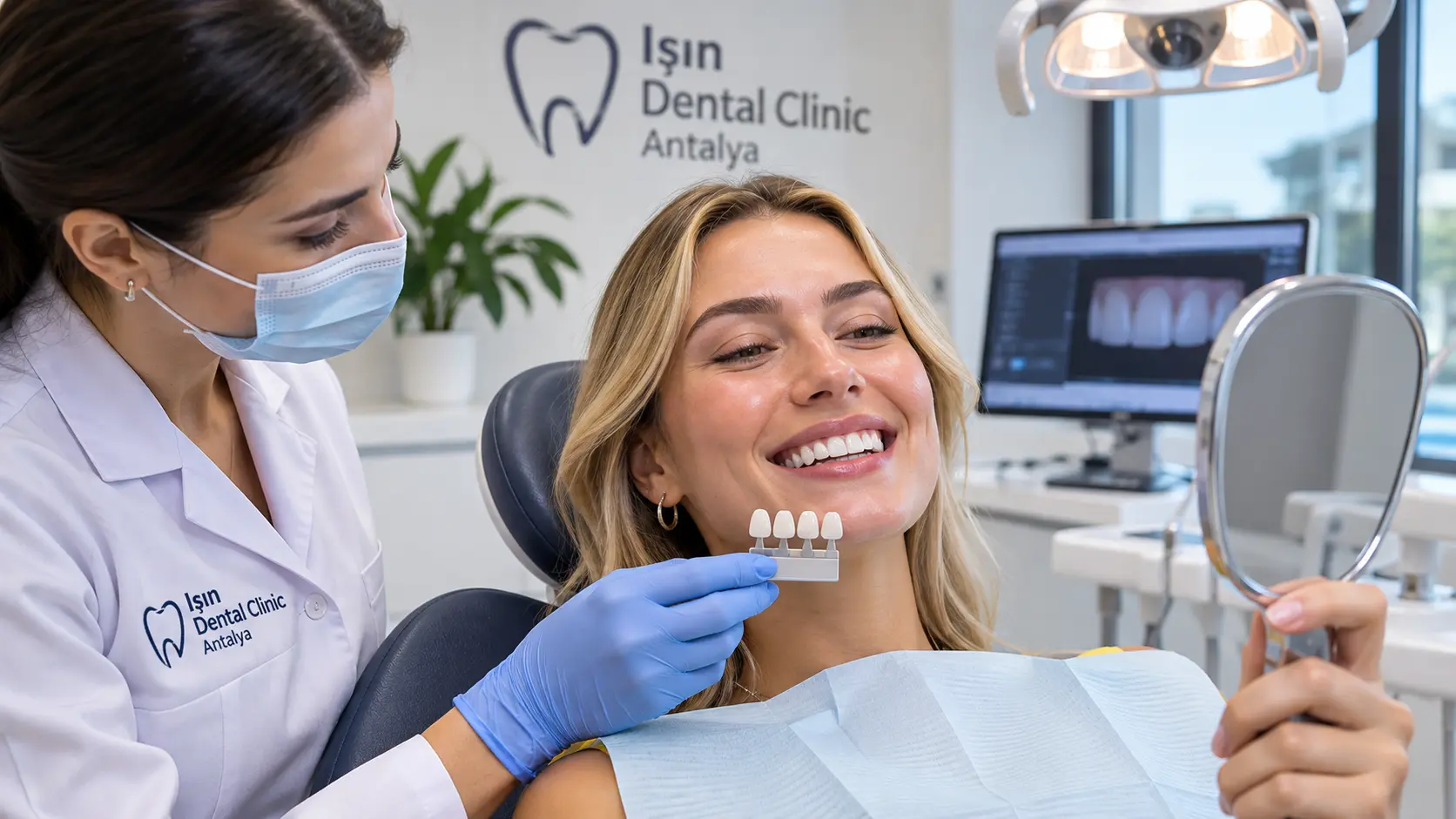
- Day 5: the try-in. The most important appointment of the week. Your finished veneers are placed temporarily so you can see them in daylight, in a mirror, with your own lips around them. Shade too bright, shape too square, edges too even: this is the moment any of that gets changed, and the veneers go back to the laboratory for adjustment if needed. After cementing, changing the shade means remaking the set.
- Day 6: final fitting and bite adjustment. The veneers are bonded, the bite is checked and adjusted, and the margins are polished. Impressions are taken for your night guard. Two to three hours.
- Day 7: check, night guard and departure. A final check, your night guard is fitted, and you are given your treatment records: the material, brand and shade of every veneer, so any dentist can match or repair them later. Transfer to the airport.
Where the try-in needs a second round of adjustment, days 5 and 6 run together and the schedule stretches by a day. That is the main reason to book slack at the end rather than the beginning.
One appointment, two to three hours for six to eight teeth. There is no laboratory stage, because the resin is built up on the tooth directly, shaped by hand and polished in the same sitting. You can fly in, have the work done in the morning, and be at dinner that evening with a finished smile.
Some cases run to a second short appointment the next day, usually where gum treatment is needed first or where a larger number of teeth is involved and we would rather not rush the sculpting. Either way, one to two days is the realistic figure, which makes composite the only genuine option if you have a long weekend rather than a week.
The trade-off is lifespan, not appearance. Composite looks very good when it is done well, but it stains more readily than porcelain and lasts around five to seven years before it needs repolishing or replacing. It is also fully reversible, because nothing is removed from the tooth, which makes it the honest first step if you are unsure about committing. See composite bonding for the detail, or our comparison of composite bonding vs veneers if you are weighing the two.
The same five to seven days as porcelain laminates, and the same appointment sequence, because E.max is also made in a laboratory.
E.max is lithium disilicate, a glass ceramic that transmits light in a way much closer to natural enamel than older feldspathic porcelain. In practice that means it looks better at the front of the mouth, where translucency is what stops a veneer reading as a false tooth, and it is strong enough to be made thinner, so less of your own enamel has to come off. On a case with heavy staining underneath, a more opaque material is sometimes the better choice, and that is a judgement made at the examination rather than from a price list.
What E.max does not change is the timeline. Any clinic quoting you a full set of E.max veneers in two or three days has removed the try-in appointment, and that is the step you most want kept. See E-max veneers and laminate veneers for how the two materials compare.
Timelines are easier to judge alongside results. Our before and after gallery shows veneer cases treated at the clinic and photographed in natural light rather than under a camera flash, which is where the difference between a natural set and an obviously artificial one shows up.
What is worth looking for is variation: slightly different lengths, edges that are not perfectly level, shades that match the patient's own age and skin tone. A gallery where every case has the same twenty identical white blocks is showing you a template, not dentistry. For why so many UK patients choose this treatment in the first place, see our piece on why people get veneers in Turkey.
Book more nights than the treatment needs. Our recommendation:
- Porcelain or E.max veneers: seven to eight nights. That covers the five to seven treatment days with a day of slack at each end, so a delayed flight or an extra try-in adjustment does not force a compromise.
- Composite veneers: three nights. One for arrival, one for treatment, one spare.
- Veneers combined with implants: two trips. Seven to ten nights for the surgery, then three to six months of healing at home, then five to seven nights for the permanent teeth. See dental implants in Turkey.
A few practical points. Fly in a day before your first appointment rather than the same morning, so a delay does not cost you the examination. Avoid booking your return flight for the evening of your final fitting, because bite adjustments sometimes need a second look the next day. Keep the first evening after preparation free, and plan soft food for it. And if you grind your teeth, say so at the consultation rather than at the end, because it changes the material choice as well as the night guard.
Treatment, hotel, VIP transfers and the night guard are priced together in our Turkey teeth packages, and the full treatment-by-treatment list is on our Antalya dentist prices page. To get a timeline built around your own teeth, send a few photographs through our free online consultation and we will tell you how many days you actually need.
How long does it take to get veneers in Turkey?
Porcelain and E.max veneers take five to seven days in Antalya, covering the examination, preparation, laboratory work, try-in and final fitting, all in one trip. Composite veneers are completed in a single appointment of two to three hours.
Can you get veneers in one day in Turkey?
Composite veneers, yes, because the resin is sculpted directly onto the tooth. Porcelain and E.max veneers cannot be done properly in a day, because they are made in a laboratory and need a try-in before cementing. A clinic offering a full porcelain set in one day has removed that step.
How many days should I book for veneers in Turkey?
Book seven to eight nights for porcelain or E.max veneers. That covers the five to seven treatment days with a day of slack at each end, so a delayed flight or an extra adjustment appointment does not cost you the try-in.
Do I need two trips for veneers?
No. Veneers are completed in a single trip because the laboratory is on site. Two trips are only needed for implants, which require three to six months of healing before the permanent teeth can be fitted.
Will I have teeth while I wait for my veneers?
Yes. Temporary veneers are fitted the same day your teeth are prepared, so you are never without teeth. They also act as a preview, and anything you dislike about their shape can be changed before the permanent set is made.
How long do composite veneers take compared with porcelain?
Composite veneers take one appointment of two to three hours for six to eight teeth, with no laboratory stage. Porcelain takes five to seven days because the shells are made in a laboratory and tried in before cementing, which is also why they last two to three times longer.