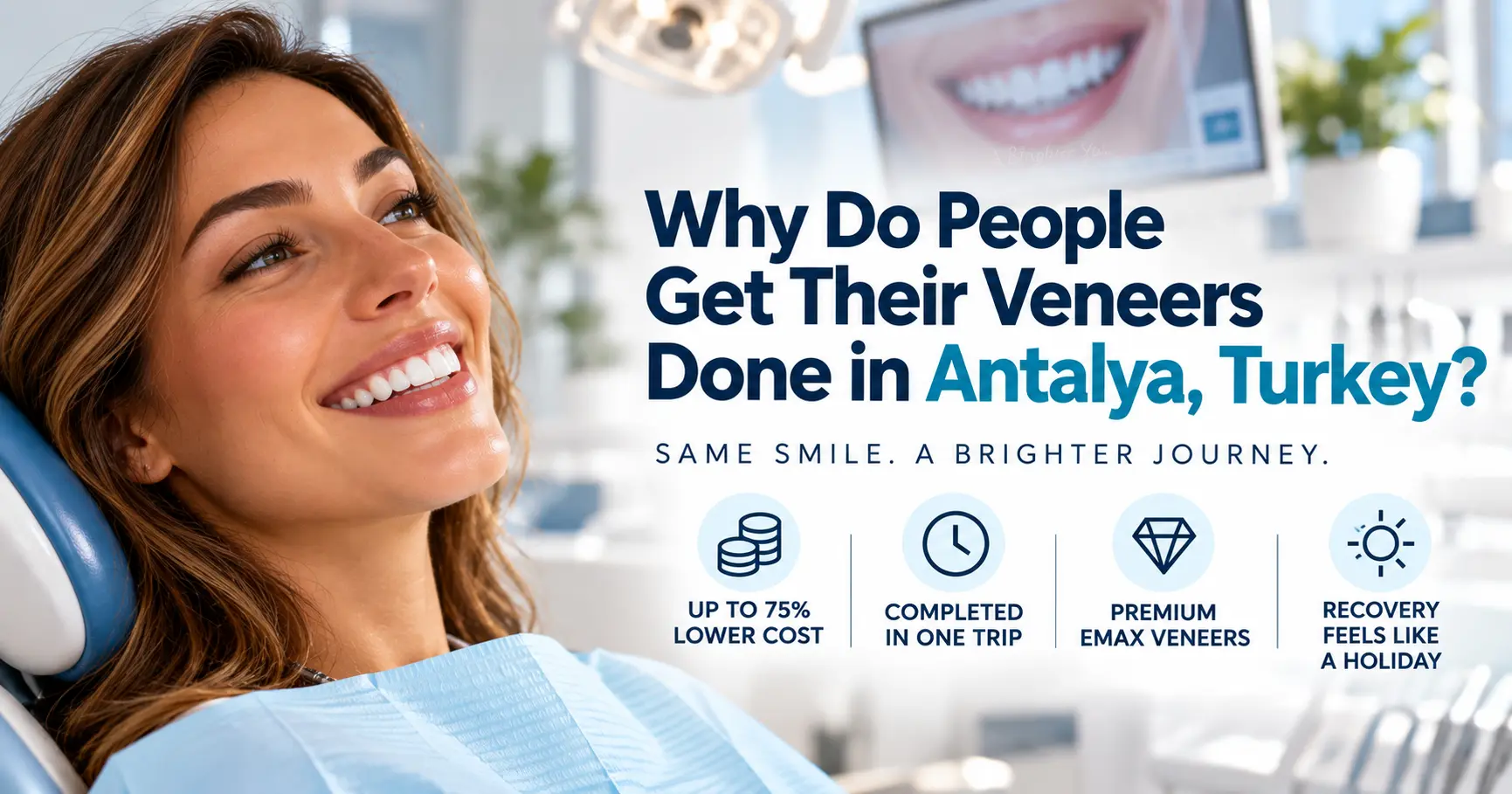
People travel to Antalya for veneers because the same treatment costs roughly a quarter of the UK price and is finished in one trip instead of several months of appointments. A full smile that runs to £16,000 or more in Britain sits between £3,500 and £5,500 here, all in. The saving comes from wages, rent and lab costs, not from the ceramic, which is bought from the same manufacturers at the same price everywhere. That is the honest core of it. The sunshine helps, but nobody boards a plane for a dental procedure because of the weather.
I have been fitting veneers for patients who fly in from the UK and across Europe for years, and the question always arrives in the same shape. Not "is it cheaper", because everyone has already done that arithmetic. It is "if it is this much cheaper, what is being left out?" That is a fair question and it deserves a straight answer, including the parts that are uncomfortable.
This is the part worth understanding properly, because it determines whether the saving is safe or not.
A dental practice in London pays London rent, London wages and London lab fees. Ours does not. A ceramist here earns a fraction of a British technician's salary, the building costs a fraction of a Harley Street lease, and the exchange rate stretches every pound further again. Clinics in Antalya also treat far more of these cases than a typical UK general practice, which keeps the chair and the lab running at a rate that drives the cost per case down.
What does not change is the material. An Emax block is made by Ivoclar Vivadent in Liechtenstein and costs the same whether it is milled in Antalya or Aberdeen. Same with the scanners, the milling units and the bonding agents. When a clinic here quotes you a low price using recognised materials, the discount is coming out of overheads, not out of your mouth.
There is a line below which that stops being true, and it is worth saying plainly. If a quote is dramatically under the range above, something is being substituted. Ask which ceramic, which brand, and get it in writing.
A large share of patients arrive asking for Emax by name, and there is a reason it dominates the conversation.
Emax is lithium disilicate, a glass ceramic that transmits light in a way very close to natural enamel. Put an opaque crown next to a natural tooth in daylight and you will see it. Put a well made Emax veneer next to one and most people cannot. It also bonds well and needs minimal tooth reduction, which matters more than almost anything else in this field.
It is not the answer to everything. For back teeth taking heavy load, or where a tooth is already heavily built up, zirconium is stronger and the sensible choice. Where the teeth are sound and the concern is purely appearance, laminate veneers remove even less tooth than an Emax crown would. We set out the differences in our comparison of veneers versus crowns.
Cost is the headline, but it is not the whole reason, and patients tell me the rest once they are in the chair.
- Cosmetic work is not available on the NHS, so the comparison at home is already private fees
- The same case at home is spread across four to six appointments over several months, each one a day off work
- Consultation fees, scan fees and design fees are often charged separately before any treatment begins
- Waiting lists for a private cosmetic consultation can run to months in some cities
- Here the whole thing is examination on Monday and a finished smile by the end of the week
The holiday element is real but secondary. People recover better sitting by the sea than commuting to work with temporaries in, and that is a genuine benefit. It is just not the reason anyone books.
If you have searched this topic at all you have seen the phrase "turkey teeth gone wrong", and I am not going to pretend those cases do not exist. They do. I see some of them, because people come here to have them corrected.
In nearly every case it comes down to one of three things.
- Healthy teeth filed down for crowns that were never needed. Crowns are faster and more profitable than veneers. A patient with sound enamel who wanted a whiter smile does not need twenty crowns, and the tooth structure removed to fit them does not grow back. This is the one that genuinely cannot be undone.
- Twenty-eight identical units in one shade. Natural teeth vary in width, length and translucency, and they are not the colour of a fridge. A smile built without regard to the face it sits in looks exactly like what it is.
- Work finished without checking the bite. If the occlusion is not adjusted properly the ceramic chips, the teeth become sensitive, and the whole case starts failing within a year or two.
Read that list again and notice what is missing from it. None of those failures has anything to do with Turkey. They are decisions a clinic made, and a clinic in any country can make them. What makes the problem more visible here is volume, because more of this work is done in Antalya than almost anywhere, so both the good results and the bad ones exist in larger numbers.
For most people who choose carefully, yes. For some, honestly, no.
It works well when your gums are healthy, your teeth are structurally sound, you have a realistic picture of the outcome, and you can give the trip a proper five to seven days. That covers the majority of the patients who contact us.
Think again when the deciding factor is purely the lowest quote you can find, when you can only spare two or three days, when you have active gum disease or untreated decay that needs sorting first, or when you are expecting a cosmetic result to fix something that is not really about your teeth. A good clinic will tell you so before you book, and being told no is a reassuring sign rather than a lost opportunity.
The difference between a good outcome and a bad one is the clinic, so put your effort there rather than into comparing prices.
- Ask which ceramic brand will be used and ask for it in writing
- Ask whether your case needs veneers or crowns, and why. If the answer is crowns for every tooth in a healthy mouth, get a second opinion
- Ask to see unedited before and after photographs of cases like yours, not a stock gallery
- Ask who is actually doing the work and what their qualification is
- Ask what happens if something needs remaking after you fly home, and what the guarantee covers
- Ask for a digital smile design preview before any tooth is touched
- Agree the shade in daylight rather than under surgery lights, and see our tooth shade guide before you decide
Vague or evasive answers to any of those are the signal. We go through the same ground for surgical cases in our guide on whether it is safe to have dental implants in Turkey, and the principles are identical.
Well made porcelain veneers last ten to fifteen years and often longer, zirconium crowns fifteen to twenty. That is the same range you would expect anywhere, because it depends on the material, the bite and how you look after them rather than on where the work was done. We cover the detail in our article on how long turkey teeth last.
The thing that shortens that life is almost never the ceramic. It is grinding without a night guard, or gum disease left unmanaged, or an aggressive preparation that left too little tooth underneath.
Why do people go to Turkey for veneers?
Mainly cost and time. A full smile of veneers or crowns runs from around £3,500 to £5,500 in Antalya against £16,000 to £24,000 in the UK, and the work is completed in one trip of five to seven days rather than spread over months. Warm weather and a recovery that feels like a holiday are a genuine part of the appeal, but almost nobody books a flight for the weather alone.
Why are veneers so much cheaper in Turkey?
Wages, rent, lab fees and running costs are a fraction of UK levels, and the exchange rate widens that further. Clinics here also work at a volume that keeps chairs and labs busy, which lowers the cost per case. None of that changes the ceramic itself. An Emax block from Ivoclar costs the same in Antalya as it does in Manchester.
Are veneers in Turkey worth it?
For most healthy patients who choose carefully, yes. The saving is real and the standard at an accredited clinic matches European benchmarks. It stops being worth it when the decision is made on price alone, when the timetable is too tight for the work involved, or when you need treatment that requires several months of follow-up close to home.
Is the quality lower than in the UK?
Not at a properly run clinic. The materials are the same brands, the equipment is often newer, and the dentists here do far more of this work per year than a typical UK general practice. What varies is the clinic, not the country. A bad clinic in Antalya and a bad clinic in London fail in exactly the same ways.
Why do people specifically ask for Emax veneers?
Emax is lithium disilicate, a glass ceramic with a translucency very close to natural enamel, so it looks convincing on front teeth in a way that opaque materials do not. It also needs very little tooth reduction. Patients arrive asking for it by name because it is the material most often shown in before and after photographs.
What does turkey teeth gone wrong actually mean?
Almost always one of three things. Healthy teeth filed down far more than the case needed, usually to fit crowns fast. Twenty-eight identical bright white units that suit nobody. Or work finished without checking the bite, which fails within a couple of years. Every one of those is a clinic decision, not a consequence of the country.
How long do I need to stay in Antalya for veneers?
Five to seven days for most veneer cases. The first day is examination, x-rays, photographs and smile design. Preparation and temporaries follow, the lab takes a few days, and the final fit happens near the end of the trip. Anyone promising a full smile in two days is cutting something out.
Do I have to fly back for check-ups?
Not for routine reviews. Veneers need the same care as natural teeth, so a hygienist at home every six months covers it, and we send your records to any dentist who asks. You would only return if something needed remaking under guarantee, and that is uncommon when the case was planned properly.
Are laminate veneers worth it compared with crowns?
If your teeth are structurally sound and the concern is colour, shape or small gaps, laminate veneers are usually the better choice because they remove far less tooth. Crowns make sense when a tooth is heavily filled, root treated or broken down. Choosing crowns for a healthy mouth is the single most common overtreatment in this field.
How do I know if I am a good candidate?
Healthy gums, enough sound enamel to bond to, and a realistic idea of the result. Active gum disease or decay is treated first. Heavy grinding needs a night guard planned in from the start. Send clear photographs of your teeth and we will tell you honestly whether veneers suit your case or whether something more conservative would serve you better.
Last of all, judge the clinic rather than the country. The saving that brings people to Antalya is real and it comes from economics, not from corners being cut, but that only holds if you pick somewhere that plans the case properly and tells you the truth about what your teeth need. Send us a few clear photographs through our free online consultation and we will tell you honestly what would suit your case, including when the answer is something smaller than you were expecting.