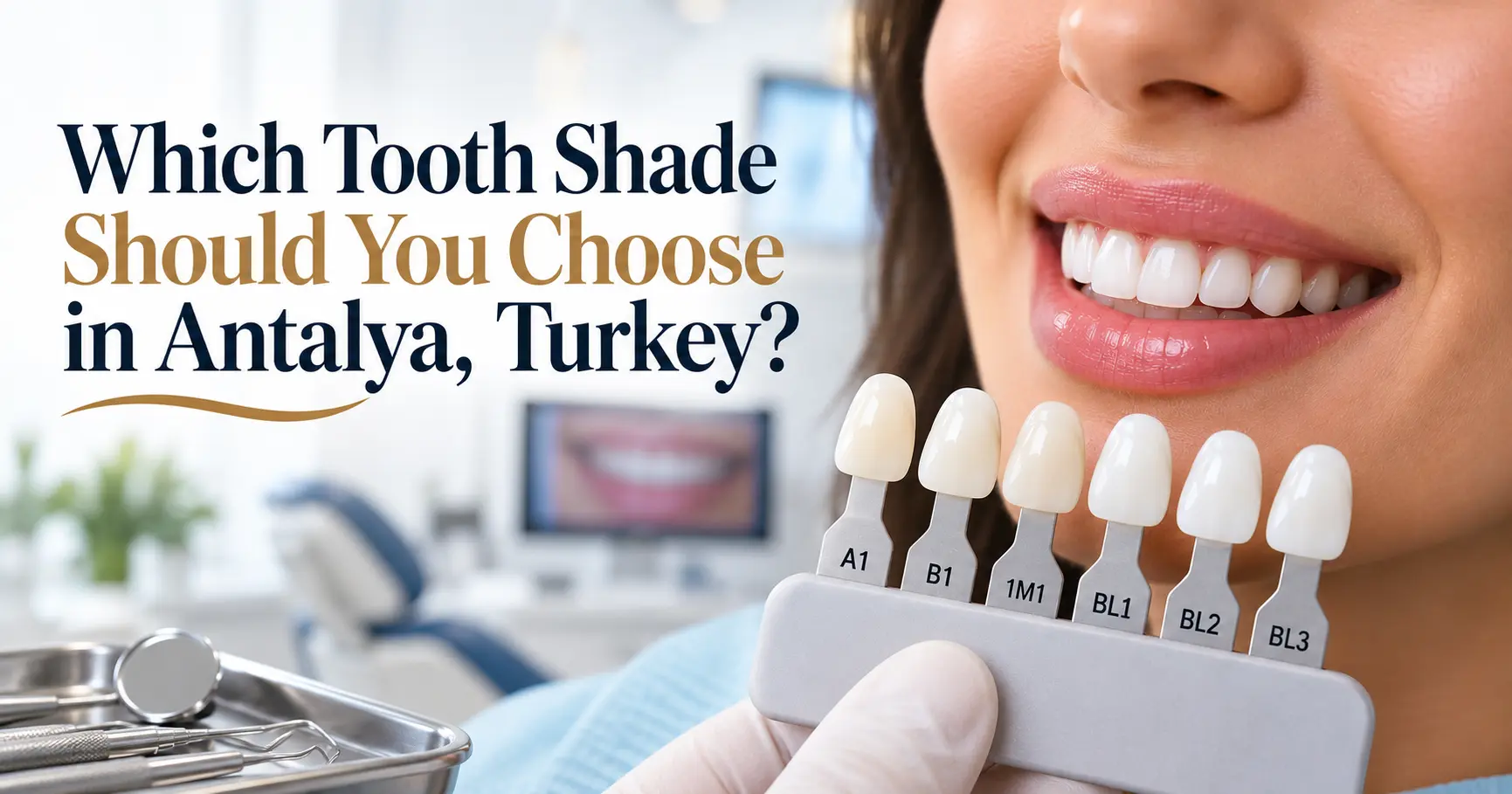
Tooth shades are standard codes rather than opinions. On the VITA Classical guide used in most clinics, B1 is the lightest shade that occurs naturally and A3 is a typical everyday adult tooth. Anything labelled BL1 to BL4 is a bleach shade, brighter than any real tooth. 1M1 belongs to a second system called VITA 3D-Master and sits at the light end of that range, close to B1. The right choice is not the whitest tab on the card. It is the one that still reads as your own face when you laugh in daylight.
Patients arrive at this conversation in one of two states. Either they have a screenshot on their phone of someone else's smile, or they have a code a clinic mentioned in passing and no idea what it means. Both are fine starting points. What worries me is the third group, the ones who shrug and say "just make them white", because that is how people end up with a smile that belongs to nobody.
Shade is the decision patients agonise over most and the one they are given the least information about. So here is what I would tell you sitting in the chair.
Ordered by how bright they read rather than alphabetically, which is how the tabs are actually sorted in the clinic.
These swatches are an illustration of the relative steps between shades. Screens vary enormously in colour accuracy, so no on-screen chart can replace holding a physical tab next to your own teeth in daylight. Use this to understand the sequence, not to pick your shade.
More people ask me this than any other shade question, and the short answer is usually no.
B1 is the lightest shade that occurs in nature. Real people walk around with B1 teeth and nobody stops them in the street. It reads as a bright, well looked after smile rather than something that was bought, which is exactly why it is the shade we fit most often.
Where it goes wrong is when the rest of the face cannot carry it. Skin loses contrast as we age, the whites of the eyes go very slightly yellow, gums recede and show darker root surfaces. Drop a uniformly bright smile into that face and the teeth stop looking like they grew there. I had a patient in her late fifties last year who was set on B1 because her daughter had it. We photographed both tabs against her face by the window, she looked at the screen, and she chose A1 herself within about ten seconds. That is usually how it goes once people see it rather than imagine it.
The shades that genuinely look artificial sit above B1, not at it. When someone says a smile looks too white, they are nearly always describing BL1 or BL2.
People come to this expecting a brightness question. It is mostly a warmth question.
B1 sits at the cooler, more neutral end and is fractionally lighter. A1 carries a faint warm cast. Hold the two tabs in your hand and honestly, most people cannot tell them apart. Hold them against a face and the difference is obvious, because warmth is what the eye reads as natural in enamel. Cold white reads as ceramic even when the shape is perfect.
- Choose B1 if you are younger, have fair or cool-toned skin, clear eye whites, and you want the result to be noticeably brighter than where you started
- Choose A1 if you are over forty, have warmer skin, or you want the work to be invisible as work. This is the shade I recommend most often
Neither is a mistake. If you genuinely cannot decide, A1 is the more forgiving of the two over the next fifteen years, because it ages alongside the face rather than against it.
If your clinic quotes 3D-Master codes, 1M1 is the one you will hear most. It is at the bright end of that system and is broadly comparable to B1, often described as sitting just between B1 and the bleach shades.
Be careful with conversion charts. The two systems were built on different principles, so matching one to the other is approximate at best, and the conversion tables floating around online do not even agree with each other. If you have spent a week reading about B1 and then get quoted 1M1, do not try to resolve it from a table. Ask to see the two tabs held together against your own teeth. It takes half a minute and it ends the argument.
BL1 through BL4 are bleach shades. Nothing in a natural mouth reaches them, and that is the point of them.
They have a proper place, and I am not going to talk anybody out of them. On a younger patient having a full arch done who wants a bright, camera-facing smile, BL3 or BL4 can look genuinely good. BL1 is the brightest tab made and it forgives nothing. It needs a face that carries it and it needs the whole arch, because a single BL1 veneer sitting next to an A3 natural tooth is about the most obvious giveaway in cosmetic dentistry.
If you are drawn to this end of the scale, look at Hollywood smile cases in unedited daylight photographs rather than in retouched galleries, and make the decision from those.
Forget the chart for a moment. There are four checks that settle this better than any code.
- The eye white test. Hold the tab next to your face and compare it with the whites of your eyes. A shade brighter than your own sclera will read as artificial in photographs. This single check prevents most regrets
- Daylight, not surgery light. Clinic lighting flatters everything. We take the tabs to a window
- Your face, not your teeth. The tab has to be judged against skin, lips and eyes together, not held against a single tooth in isolation
- A photograph. We photograph the shortlisted tabs against your face and look at them on a screen. People choose differently once they see themselves rather than a mirror image
We also plan the shade as part of the digital smile design, so you see the proposed result before a single tooth is prepared.
Here is something almost nobody is told: the same code does not look the same in every material.
Emax is a glass ceramic with high translucency, so it picks up light and a little colour from what sits behind it. That is what makes it look convincing on front teeth, and it also means the underlying tooth affects the final result. A dark or root-treated tooth under a translucent veneer will pull the shade down unless it is masked first.
Zirconium is more opaque, which makes it excellent at hiding discoloured teeth underneath and slightly flatter in the way it handles light. Laminate veneers are very thin, so the tooth beneath them shows through more than most patients expect. We go through the differences in our comparison of veneers versus crowns.
What this means for you is straightforward. Describe the result you want and let your dentist work backwards to the material that gets there. Picking a material and a shade as two separate decisions is how people end up disappointed with a technically perfect set of veneers.
Whitening and veneers have to happen in a particular order, and this one is not negotiable.
Ceramic does not whiten. Once a veneer or crown is made, that shade is fixed for as long as you own it. So if any of your own teeth are going to be whitened, that happens first, then you wait about two weeks for the shade to settle back slightly, and only then do we lock in the restoration shade to match. Get the order wrong and you have whitened natural teeth sitting beside a crown that suddenly looks grey. I see that correction request more often than I would like, and it means remaking the crown.
You can read more about the process on our teeth whitening page. For a full arch this step is unnecessary, because nothing natural remains visible to match to.
Almost everything else in a veneer case can be adjusted. Shape can be refined, length can be trimmed, a chip can be polished. Shade cannot. Changing it means remaking the restorations and paying for them again.
Well made ceramic also holds its colour for the life of the restoration, which is ten to fifteen years for veneers and longer for zirconium, so this is a decision you live with for a long time. We cover durability in our article on how long turkey teeth last.
Take the extra appointment. Look at the tabs in daylight. Ask for photographs. Any clinic that rushes you through the shade conversation is telling you something about how it handles the rest of the case, which is a point we make in our honest look at why people get their veneers done in Antalya.
What do tooth shade codes like A1 and B1 mean?
They come from the VITA Classical guide, the standard used in most clinics. The letter is the colour family: A is reddish brown, B reddish yellow, C grey and D reddish grey. The number is how saturated that colour is, with 1 the lightest. So B1 is the lightest shade in the natural range and A3 is a common everyday adult shade.
Is B1 tooth shade too white?
Not usually. B1 is the lightest shade that still occurs in nature, so it reads as a very bright but believable smile, particularly on younger patients with fair skin. It tips into looking artificial when the face around it does not support it, meaning older skin, darker eye whites or heavy gum recession. The bleach shades above B1 are the ones that most often look fake.
What is the difference between A1 and B1?
Both are light, and the difference is warmth rather than brightness. B1 sits at the cooler, slightly more neutral end, while A1 carries a faint warm cast that many faces read as more natural. B1 is marginally lighter. In practice A1 is the safer choice for most adults over forty and B1 suits younger patients or anyone wanting a noticeably brighter result.
What does 1M1 tooth shade mean?
1M1 comes from the VITA 3D-Master system rather than the Classical guide. The first number is brightness, with 1 the brightest level, M means the middle or medium hue group, and the last number is chroma. It sits at the light end of the range and is broadly comparable to B1, though cross-system matches are approximate and should always be confirmed against a physical tab.
Is 1M1 whiter than B1?
They are very close, and which one looks lighter depends on the lighting and the material used. 1M1 is often described as sitting between B1 and the bleach shades. If your clinic quotes shades in the 3D-Master system and you have been researching Classical codes, ask them to show you both tabs side by side rather than relying on a conversion chart.
What are BL1, BL2 and BL3 shades?
They are bleach shades, brighter than anything that occurs in a natural tooth. BL1 is the whitest, then BL2, BL3 and BL4 stepping down towards the natural range. These produce the very bright look people associate with a Hollywood smile. They can look excellent on the right face and obviously artificial on the wrong one, which is why they should be chosen in daylight with your face in the mirror.
What shade are natural teeth?
Most adult teeth sit around A2, A3 or B2. Teeth also darken gradually with age as enamel thins and the dentine underneath shows through, so a shade that looks natural at twenty-five can look slightly grey at sixty. This is why matching a single crown to your own teeth uses a different logic from choosing a shade for a full smile.
How do I choose a shade that does not look fake?
The most reliable guide is the whites of your eyes. A shade brighter than your own sclera tends to read as artificial in photographs. Beyond that, consider skin tone, age and how much of the smile shows when you talk. We take photographs with shade tabs against your face in natural daylight and review them together before anything is made.
Should I whiten my teeth before getting veneers?
If only some teeth are being treated, yes. Veneers and crowns do not respond to whitening once they are made, so the natural teeth beside them must be brought to their final shade first, then left to stabilise for about two weeks before the shade is locked in. For a full arch of veneers this step is unnecessary.
Can the shade be changed after the veneers are fitted?
No. Ceramic does not whiten and it cannot be lightened afterwards, so changing the shade means remaking the restorations at full cost. This is the single most important reason to take the shade decision slowly, see the tabs against your own face in daylight, and ask for a trial smile or digital preview before anything is prepared.
Last of all, resist the pull of the brightest tab on the card. The smiles that still look good in photographs ten years later are almost never the whitest ones, they are the ones matched to the face they belong to. Send us a few clear daylight photographs through our free online consultation and we will tell you which shades would suit you, and which one we would pick if it were our own smile.