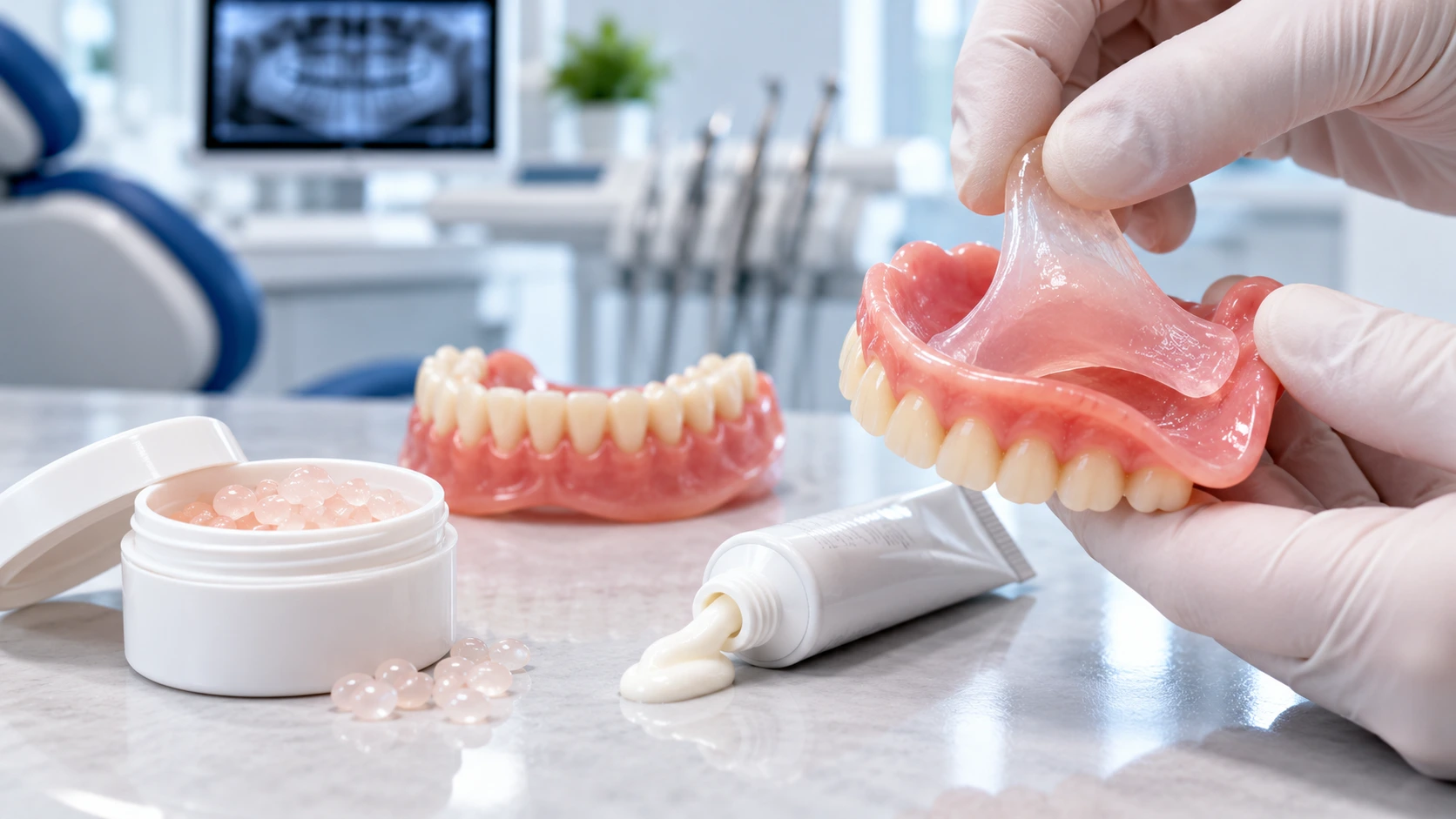
Thermoplastic denture adhesive is a resin that softens in hot water and sets firm as it cools, moulding into the fitting surface of your denture to form a cushion. It grips far better than a cream, which is exactly why people switch to it. The material is not dangerous in itself. The problem is what it conceals: a denture that no longer fits the jaw underneath, because that jaw is still shrinking. As a stopgap for a few weeks it is perfectly reasonable. As a permanent arrangement it quietly makes the underlying situation worse.
Patients rarely bring this up on their own. It usually comes out halfway through an examination, slightly sheepishly, as though they have been caught doing something wrong. They have not. When a denture keeps dropping at dinner and the next appointment is months away, you use what works. But almost nobody is told what the trade-off actually is, so here it is.
| Feature | Cream or powder | Thermoplastic |
|---|---|---|
| How it holds | Thin sticky film | Solid moulded cushion |
| Grip through the day | Fades after a few hours | Holds, often for days |
| Removed each night | Yes, rinses off | Usually left in place |
| Effect on your bite | Negligible | Raises and alters it |
| Cleaning underneath | Straightforward | Difficult |
| Hides a poor fit | Only partly | Completely |
If you only care about getting through a wedding without your lower denture moving, the right-hand column wins. If you care about where your mouth is in three years, the comparison is less flattering. We go through the ordinary cream and powder options in our guide to the best denture adhesive.
This is the question people actually want answered, so let me take it in two parts.
The material. The thermoplastic resins sold for this purpose are not toxic and I have not seen a patient harmed by the substance itself. On that narrow question, it is safe.
What it does over time. This is where my answer changes, and there are four specific problems.
- It changes your bite. You are adding several millimetres of material under the denture. The upper and lower teeth now meet differently, and over months that loads your jaw joint and the remaining ridge in ways the denture was never designed for
- Cleaning becomes very difficult. A cream washes away nightly. A moulded layer left in place for days collects plaque and food debris against tissue that cannot be inspected or brushed properly. Sore, inflamed patches under long-worn liners are something I see regularly
- It masks the real problem. This is the serious one. A loose denture is information. It is telling you the bone has changed shape. Filling the gap silences the message without addressing anything
- It complicates proper treatment. Before a laboratory can reline a denture, every trace of old liner has to be stripped out. Months of built-up material make that harder and occasionally damage the acrylic on the way
So the honest verdict: not harmful for a few weeks, not a good idea for a few years.
People search for a winner here, and I have to be straight with you: the brands sold under names like Thermodenta and DinaBase are variations on the same idea, and no dentist can tell you which tub performs better in your mouth. What separates them matters less than how they are used.
What does differ, and is worth checking before you buy:
- Softening temperature. Some need water hot enough to risk a burn. Anything that has to be near boiling is a product to handle carefully, especially if your hands are not steady
- How easily it comes out. The firmer and more rubbery the set material, the harder it is to remove cleanly when you finally see a dentist
- How thick a layer it forms. Thicker means better grip and a bigger change to your bite. This is the trade-off nobody puts on the packaging
The reviews are polarised for a reason that has nothing to do with quality control. Wearers whose denture is only slightly loose get an excellent result and write glowing reviews. Wearers whose denture no longer fits at all need such a thick layer that the bite goes wrong, the gum gets sore, and they write furious ones. Same product, two different underlying problems.
So the honest answer to which is best is that the question is slightly off. If a thin application fixes it, almost any of them will do. If you need to pack it in, no brand will save you, and that is the signal to have the denture relined properly rather than to try the next tub.
Nobody explains this clearly enough, and it changes how you see the whole situation.
When a tooth is removed the root goes with it, and the bone that held that root begins to resorb because nothing is loading it any more. The loss is quickest in the first year and then continues, slowly, for the rest of your life. A denture rests on that ridge and presses down on it, which does not help.
Your denture was made to fit a jaw that no longer exists in that shape. It did not fail. The ground underneath it moved. That is why the amount of adhesive you need keeps creeping up, and why a thicker cushion only buys time.
Four options, from least to most permanent. All of them deal with the cause rather than the symptom.
| Option | What happens | Suits you if |
|---|---|---|
| Professional reline | Fitting surface reshaped to your current gum | The denture is sound and the bite is fine |
| New denture | Made from fresh impressions | The current one is worn or the bite has collapsed |
| Implant overdenture | Clips onto two to four implants, still removable | You want security without a fixed bridge |
| Fixed implant bridge | Teeth fixed permanently on four or six implants | You want nothing removable ever again |
Start at the top. A reline costs a fraction of anything below it and solves the problem outright for many people, particularly if the denture is only a few years old. There is no reason to jump to implants if a reline will do.
The middle option is the one most denture wearers are never offered. An implant-supported overdenture uses two to four implants to lock the denture onto clips or a bar. It still comes out for cleaning, it costs far less than a full fixed arch, and the adhesive question disappears permanently. For lower dentures, which are the ones that never stay put, it is often the single best answer.
If you want to compare the removable and fixed routes properly, we set them side by side in dental implants vs dentures, and the full-arch options are covered on our All-on-4 and All-on-6 pages.
I am not telling anyone to throw the tube away. There are situations where reaching for it is the sensible thing to do.
- You have an appointment booked and need to get through the next few weeks
- You are travelling and cannot see your own dentist
- There is an occasion coming up and you want certainty for one day
- A new denture is being made and the old one has to last a little longer
What turns it into a problem is drift. It starts as a temporary fix, the appointment never gets booked, and two years later it is simply how the denture works. If that describes you, nothing bad has happened yet, but the clock has been running.
Patients hide this and they should not. It is not a confession, it is clinical information.
We need to know because every trace has to be removed before an impression can be taken, because the tissue underneath may be inflamed and needs to recover before we record anything, and because a bite that has been propped up for months reads differently. Knowing in advance saves an appointment and gives you a better result.
Almost always, and this is the question that stops people from asking at all.
Long-term denture wearers have lost bone, that part is true. But All-on-4 angles the rear implants to use the densest bone remaining and frequently avoids grafting altogether. Where the upper jaw has severe loss, zygomatic implants anchor into the cheekbone and treat cases that used to be declared hopeless. Very few patients turn out to be untreatable.
If you have been told elsewhere that there is nothing to work with, that verdict came from an opinion or a flat x-ray. A 3D scan is what actually settles it. Patients travelling to us from the UK and Europe can read how the process works in our guide on whether it is safe to have dental implants in Turkey.
What is thermoplastic denture adhesive?
It is a resin that softens in hot water and sets firm as it cools. You press the softened material into the fitting surface of the denture, bite down, and it moulds to the shape of your gum. The result is a thick cushion that fills the gap between denture and gum, which is why it grips far more firmly than a cream. It is closer to a do-it-yourself reline than to a conventional adhesive.
Is thermoplastic denture adhesive safe?
The material itself is not harmful, and plenty of people use it without immediate problems. The risk is in what it does over months. It changes how your denture meets your bite, it is difficult to clean properly so bacteria collect underneath, and most importantly it hides a denture that no longer fits. Used for a week while you wait for an appointment it is reasonable. Used for a year it is not.
Is it better than normal denture adhesive cream?
For grip, yes, and that is why people switch to it. A cream is a thin film that wears off through the day, while a thermoplastic layer is a solid cushion that stays put. But cream washes off cleanly every night and lets your dentist see how the denture actually sits. Thermoplastic does neither, so the better hold comes with a trade-off most packaging does not mention.
Why has my denture stopped fitting?
Because the bone underneath is shrinking. Once the tooth roots are gone, the jawbone that held them resorbs steadily, faster in the first year and continuing for life. Your denture was made to fit a jaw that no longer exists in that shape. No adhesive stops that process, which is why the amount you need keeps creeping up.
Can thermoplastic adhesive damage my denture?
It can. Repeated heating and the bulk of material pressed inside can stress the acrylic, and removing hardened layers sometimes takes material with it. It also makes a professional reline harder, because the laboratory has to strip every trace of the old liner before taking a proper impression. Tell your dentist you have been using it rather than letting them find out.
What should I use instead?
In order of permanence: a professional reline, which reshapes the fitting surface to your current gum for a fraction of the cost of a new denture; a new denture if the existing one is worn or the bite has collapsed; an implant-supported overdenture, which clips onto two to four implants and removes the problem entirely; or a fixed bridge on implants. Which one suits you depends on how much bone is left.
How long can I keep using it?
Treat it as a bridge to an appointment, not a long-term plan. A few weeks while you arrange treatment is sensible. Months of daily use means you are managing a symptom while the cause gets worse, and the bone loss that made the denture loose carries on regardless of how well it is gripping today.
Does using adhesive mean I need implants?
Not automatically. If your denture is only a few years old and the bone is stable, a reline often solves it completely. Implants become the sensible answer when you have been through several relines, when the lower denture will not stay put whatever you do, or when you are tired of the whole routine. A scan tells us which situation you are in.
Will a dentist refuse to treat me if I have used it?
No. We see it regularly and nobody is going to lecture you. What we do need is honesty about how long it has been in place, because it changes how we take the impression and what we expect to find underneath. Patients often apologise for it, and there is nothing to apologise for.
Can I have implants if I have worn dentures for years?
In most cases yes. Long-term denture wearers have lost bone, but angled techniques such as All-on-4 are designed for exactly that and frequently avoid grafting. Where the upper jaw has severe loss, zygomatic implants anchor into the cheekbone instead. Being told elsewhere that you have no bone is worth a second opinion and a 3D scan.
Last of all, if you are reaching for this product every day, the useful thing it is telling you is not which brand to buy next. It is that your denture and your jaw have drifted apart, and that is fixable. Send us a few photographs through our free online consultation and we will tell you honestly whether a reline would sort it, or whether it is worth looking at something that never needs glue again.