
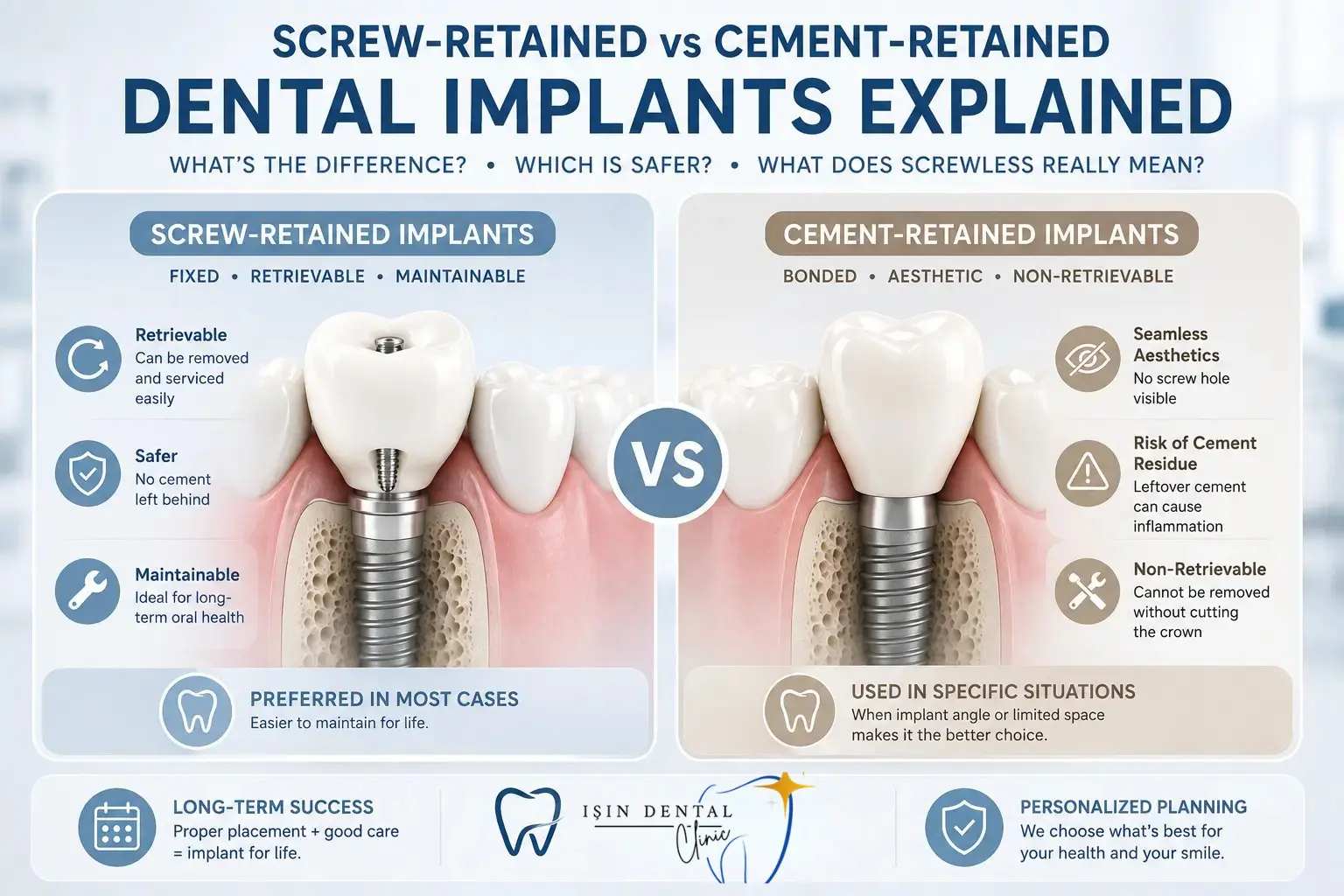
The choice between screw-retained and cement-retained implants is not a choice between two kinds of implant. Every conventional dental implant is a screw-shaped titanium post placed into the jawbone. What differs is how the crown on top is attached: a screw-retained crown is secured with an access screw through the biting surface and can be unscrewed by your dentist at any time, while a cement-retained crown is bonded onto an abutment and cannot be removed without cutting it off. Screw-retained is preferred in most cases today because it is retrievable and leaves no cement below the gum. Cement-retained is chosen when the implant angle or the available space makes it the better result.
Patients ask about this constantly, usually after reading about a screwless implant somewhere and wondering whether they are being offered something inferior. The short answer is that the phrase is marketing rather than dentistry, and the real decision is a technical one your surgeon makes from your CT scan. Here is what is actually going on.
| Feature | Screw-retained | Cement-retained |
|---|---|---|
| How it attaches | Access screw through the crown | Bonded onto an abutment |
| Removable by dentist | Yes, in minutes | No, must be cut off |
| Residual cement risk | None | Present, needs careful technique |
| Visible access hole | Filled and polished, usually hidden | None |
| Needs vertical space | More | Less |
| Handles awkward angles | Limited without angled abutment | Better |
| Repair if a problem arises | Unscrew, service, refit | Cut off and remake |
| Used for full arches | Yes, standard | No |
Two reasons, and both are practical rather than theoretical.
Retrievability. Implants are a long-term investment and things occasionally need attention over twenty years. A screw can loosen, a porcelain edge can chip, the gum around an implant can need treatment. With a screw-retained crown your dentist removes the composite filling from the access channel, unscrews the crown, deals with the problem and puts the same crown back. With a cemented crown, the crown is cut off and a new one is made and paid for.
No cement below the gum. When a cement-retained crown is seated, excess cement is squeezed out at the margin. If that margin sits below the gum line, the excess is difficult to see and difficult to remove completely. Cement left behind acts as a permanent irritant and is a well-documented trigger for peri-implantitis, the inflammation and bone loss that is the leading cause of implant failure. A screw-retained crown has no cement at all, so the risk simply does not exist.
Cement-retained restorations have not been abandoned, and there are situations where they clearly produce the better outcome.
- Unfavourable implant angle. If the implant is angled such that the screw channel would emerge on the visible front surface of an upper front tooth, a screw-retained crown means a composite patch in the middle of your smile. Cement solves that cleanly.
- Limited vertical space. A screw channel needs height. Where the gap between upper and lower jaws is shallow, a cemented crown fits where a screw-retained one will not.
- Passive fit across multiple units. On some short bridges, cement can compensate for small discrepancies in fit that a rigid screw connection would transmit as stress.
Where a front tooth needs cement for aesthetic reasons, a good compromise exists. An angled screw channel abutment redirects the access hole from the front surface to the back of the tooth, giving the aesthetics of cement with the retrievability of a screw. It is not available in every case, but it is worth asking about.
Full-arch bridges are screw-retained as standard, and this is settled practice rather than a matter of taste. A bridge carried on four or six implants has to come off for maintenance, for repair, and for periodic deep cleaning of the tissue underneath. Cementing an arch that size would also make excess cement nearly impossible to control along its length.
The retrievability matters for your routine too. Your dentist can unscrew the bridge annually for a thorough clean underneath, which supports the daily routine we describe in our guide on how to clean All-on-4 and All-on-6 implants. The two procedures themselves are compared in our article on All-on-4 vs All-on-6.
You should not be paying more for one system than the other, and at our clinic you do not. The decision is made on your 3D CT scan from the planned implant position and angle, and we tell you which one you are getting before treatment starts.
Be cautious of any quote that presents a screwless implant as a premium upgrade at extra cost. It is a crown attachment method chosen for technical reasons, not a superior class of implant. Our single implant pricing, including the abutment and crown, is on our dental implant treatment page and current packages are listed on our price list.
The sequence is the same for every patient. A 3D CT scan shows bone height, width, density and the position of nerves and sinuses. From that we plan where each implant can be placed safely, and the planned angle determines where a screw channel would emerge. If it emerges somewhere invisible, you get a screw-retained crown. If it would emerge through the front of a visible tooth and an angled channel abutment cannot redirect it, you get a cement-retained crown seated with a technique that keeps the margin accessible.
The aim is not to use one system dogmatically. It is to give you a restoration that looks right, functions properly and can still be serviced in fifteen years. If you are weighing implants against a removable option first, our comparison of dental implants vs dentures covers that decision, and questions about having the work done in Turkey are answered in our guide on whether it is safe to have dental implants in Turkey.
What is the difference between screw-retained and cement-retained implants?
The difference is how the crown is attached to the implant, not the implant itself. A screw-retained crown is held by an access screw through the biting surface and can be unscrewed by your dentist at any time. A cement-retained crown is bonded onto an abutment with dental cement and cannot be removed without cutting it off.
Is there such a thing as a screwless dental implant?
Not in the way the phrase suggests. Every conventional dental implant is a screw-shaped titanium post placed into the jawbone. What clinics call a screwless implant is almost always a cement-retained crown, meaning there is no visible access screw in the biting surface. The implant underneath is the same.
Which is better, screw-retained or cement-retained?
Screw-retained is preferred in most modern implant dentistry because it is retrievable and leaves no cement behind. Cement-retained is chosen when the implant angle would place the screw hole in a visible front surface, or when the space between the jaws is too shallow for a screw channel. The choice is dictated by position and angle, not by preference.
Why does leftover cement cause problems?
Cement squeezed out below the gum line during fitting is hard to see and hard to remove. Left in place it behaves like a permanent foreign body, triggering inflammation that can progress into peri-implantitis and bone loss. Residual cement is a well-documented cause of implant complications, which is why screw-retained restorations are often preferred.
Can you see the screw hole on a screw-retained crown?
The access channel is filled with tooth-coloured composite and polished flush, so it is rarely noticeable on back teeth. On front teeth an unfavourable implant angle can place the channel on the visible surface, which is precisely when we choose a cement-retained crown or use an angled screw channel abutment instead.
Can a cement-retained crown be removed if something goes wrong?
Not without destroying it. If the crown needs servicing, the abutment screw needs tightening or the implant needs treatment, a cemented crown usually has to be cut off and remade at additional cost. This retrievability difference is the single strongest practical argument in favour of screw-retained restorations.
Are All-on-4 and All-on-6 bridges screw-retained?
Yes, full-arch bridges are screw-retained as standard. A bridge carried on four or six implants must be removable for maintenance, repair and periodic deep cleaning underneath, and cementing an arch of that size would make residual cement almost impossible to control. This is settled practice rather than a preference.
Does the choice affect how long the implant lasts?
The implant itself lasts the same either way when it is placed correctly and kept clean. What differs is the ease of managing problems over the years. A screw-retained crown can be removed, serviced and refitted, while a cemented one is remade. Over a twenty year horizon that difference has a real cost.
Does a screw-retained crown come loose?
Screw loosening happens occasionally, usually from heavy bite forces or grinding, and it presents as a slight click or movement. It is a minor issue precisely because the crown is retrievable: your dentist removes the composite filling, retightens the screw to the correct torque and seals it again in one short appointment.
Which one will I be given at Işın Dental Clinic?
That is decided from your 3D CT scan and the planned implant angle, and we tell you which one before treatment begins. We use screw-retained restorations wherever the position allows, and cement-retained where aesthetics or limited space make it the better result. You will never be charged differently for one over the other.
Last of all, do not let this decision worry you, and do not let anyone sell it to you as an upgrade. Both systems work when they are used in the right situation by someone who knows why they are choosing it. Send a few photographs and any scans you have through our free online consultation and our surgeon will tell you exactly which approach your case calls for and why.